
For a multifamily operator managing more than a handful of properties, the most expensive problem is rarely a single underperforming campaign.
It is the gap between the moment something starts going wrong at one property and the moment leadership actually knows about it. That gap is almost always the result of the same root cause, and it has very little to do with the team. It has to do with the systems they are working in, and it has quietly become one of the most costly inefficiencies in multifamily marketing today.
The Real Cost of Operating Without a Unified View
Most multifamily operators today are running on a patchwork of platforms. Paid media performance lives in one ad manager, organic traffic in an analytics tool, lead flow in the CRM, leases and tours in the property management system, reputation in a review platform. Each system does its job well, and each one tells a piece of the full story.
The trouble is that the full picture only emerges when someone manually stitches the pieces together. That stitching usually happens once a week in a spreadsheet either by an analyst or a marketing manager who is exporting reports, normalizing column names, and reconciling numbers that do not always agree.
By the time the picture is whole, it is already several days old. Decisions made from it are reacting to a market that has already moved.
The Data Fragmentation Problem in Multifamily
Multifamily marketing teams sit at the intersection of more data sources than almost any other vertical. A single property can pull in performance signals from paid search, paid social, ILS listings, the property's own website, organic search, review platforms, the leasing CRM, and the property management system. Each of those tools was built by a different company, for a different purpose, with a different definition of what a "conversion," a "lead," or a "lease" actually is.
For a single property, that is manageable. For a portfolio of fifty, it becomes a structural problem. Regional managers cannot answer simple questions without filing a request. "Which three properties had the worst tour-to-lease conversion last week?" is a thirty-second question that often takes three days to answer, because the data lives in three or four different systems that do not talk to each other.
The result is a team that spends more time assembling reports than acting on them, and the larger the portfolio grows, the worse the math gets.
What Portfolio Visibility Actually Means
Portfolio visibility is a phrase that gets used loosely in the industry, and it is worth being precise about what it does and does not mean.
It does not mean a prettier dashboard. A dashboard that pulls from one or two sources and ignores the rest is just a nicer-looking partial picture. It does not mean a monthly executive rollup, either. Rollups summarize what already happened, which does not help anyone change what is happening right now.
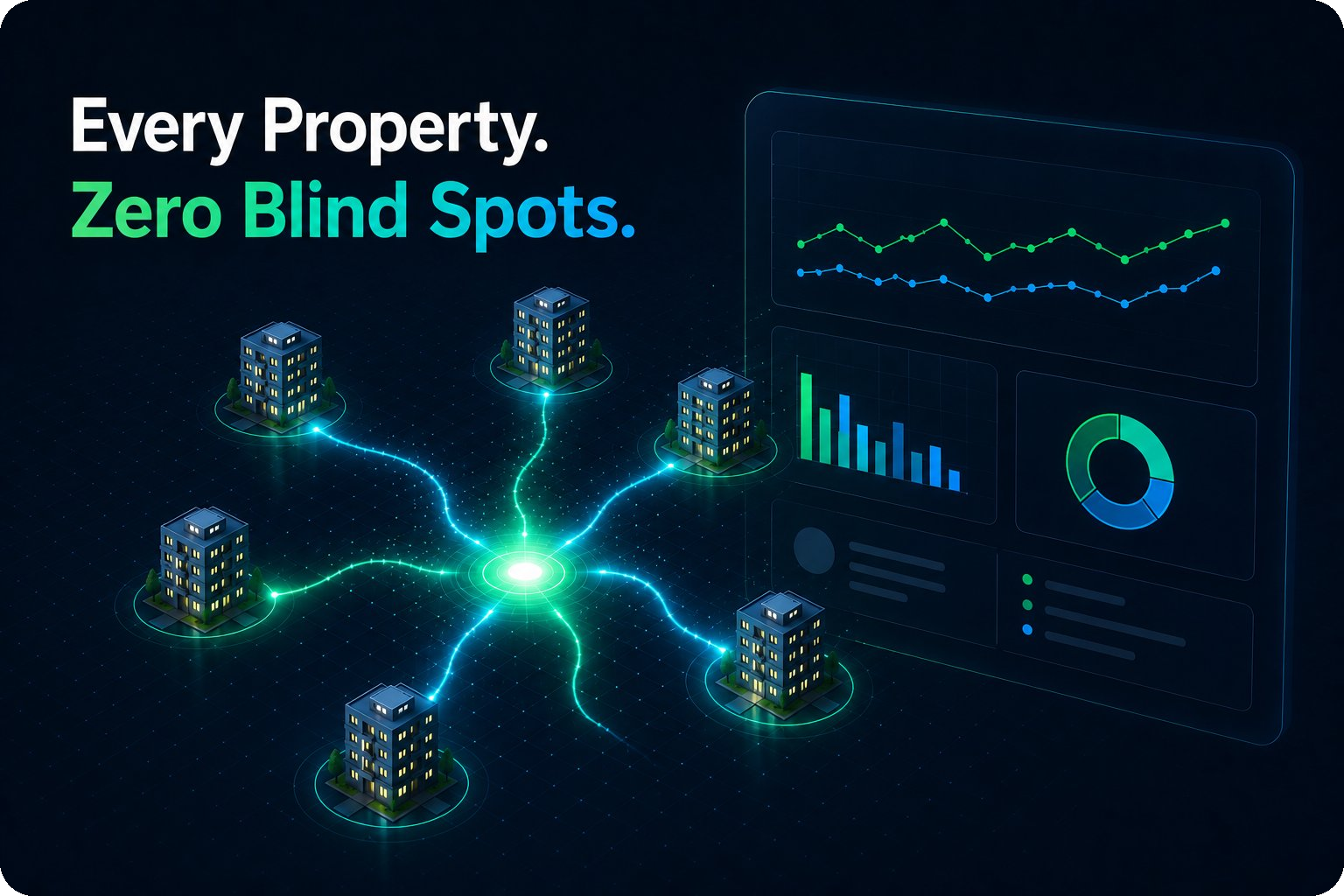
Real portfolio visibility is made up of three things working together. First, every relevant data source for every property is connected and updating continuously, so the numbers that a regional manager sees on Tuesday morning reflect Monday's activity. Second, those numbers are comparable across the portfolio, so a property in Charlotte and a property in Phoenix can be evaluated against each other using the same definitions. Third, the view is structured around how the team actually works, with the ability to look across the whole portfolio, drill into a single property, or group properties by client, region, or any other dimension that matters to the operator.
When those three things are in place, the question of "what is happening across our portfolio right now" becomes answerable in seconds rather than days.
Kyzen V4 Beta's Portfolio Layer
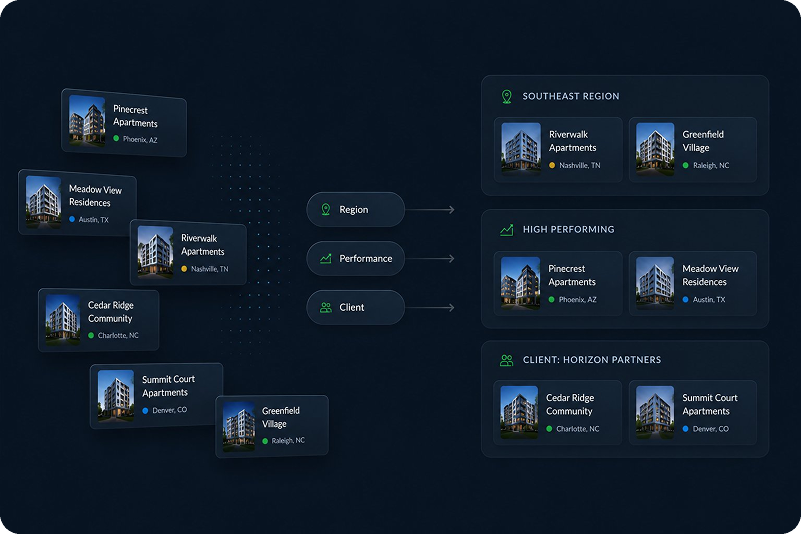
V4 Beta was built around this exact problem. At its core is a portfolio layer that connects every relevant data source for every property in a single, continuously updating view, and lets teams move between the portfolio, a group of properties, and an individual property without ever leaving the same context.
Properties can be grouped by client, region, or any dimension the team chooses, so the way Kyzen organizes the portfolio matches the way the team actually thinks about it. Performance comparisons across the portfolio use consistent definitions, so a number on one property is directly comparable to the same number on another. Real-time updates from connected ad platforms, analytics tools, CRMs, and property management systems mean the view is never more than a few minutes behind the activity it is reflecting.
The result is a single place where a regional manager can scan a hundred properties, identify the three that need attention this morning, and act on them before the day is over.
What Becomes Possible With Real Portfolio Clarity
The operational shift that comes with this kind of visibility is bigger than most teams expect. A few patterns tend to emerge once the data is finally working together.
Performance Meetings Become Working Sessions
Weekly performance meetings stop being reporting exercises. Instead of spending the first thirty minutes reviewing what the numbers say, the team starts with the numbers already on the wall and uses the meeting to decide what to do about them. The conversation moves from "what happened" to "what we are going to do about it."
Budget Decisions Move at the Speed of the Leasing Cycle
Budget reallocations happen on the timescale of leasing cycles instead of fiscal quarters. A property that needs more paid search support in week two does not have to wait until the month-end review to get it. The teams that can move spend in days rather than weeks consistently outperform teams of similar size and budget.
Issues Get Caught Earlier, and Wins Get Studied Earlier
Underperforming properties get noticed before a slow month becomes a slow quarter. Outperforming properties get studied just as quickly, and the lessons that travel best across a portfolio are the ones identified while they are still happening.
Client Conversations Shift From Defense to Planning
When an agency or owner can show a portfolio-level view that ties every dollar of marketing spend to every signed lease, the conversation moves away from defending performance and toward planning the next move.
See It June 15
Kyzen V4 Beta arrives on June 15. The portfolio layer is one of several capabilities being introduced, and it is the foundation that the rest of the platform is built on.
For multifamily operators who have spent the last several years stitching reports together by hand, this is the version built for the way the work actually happens.